In Threes
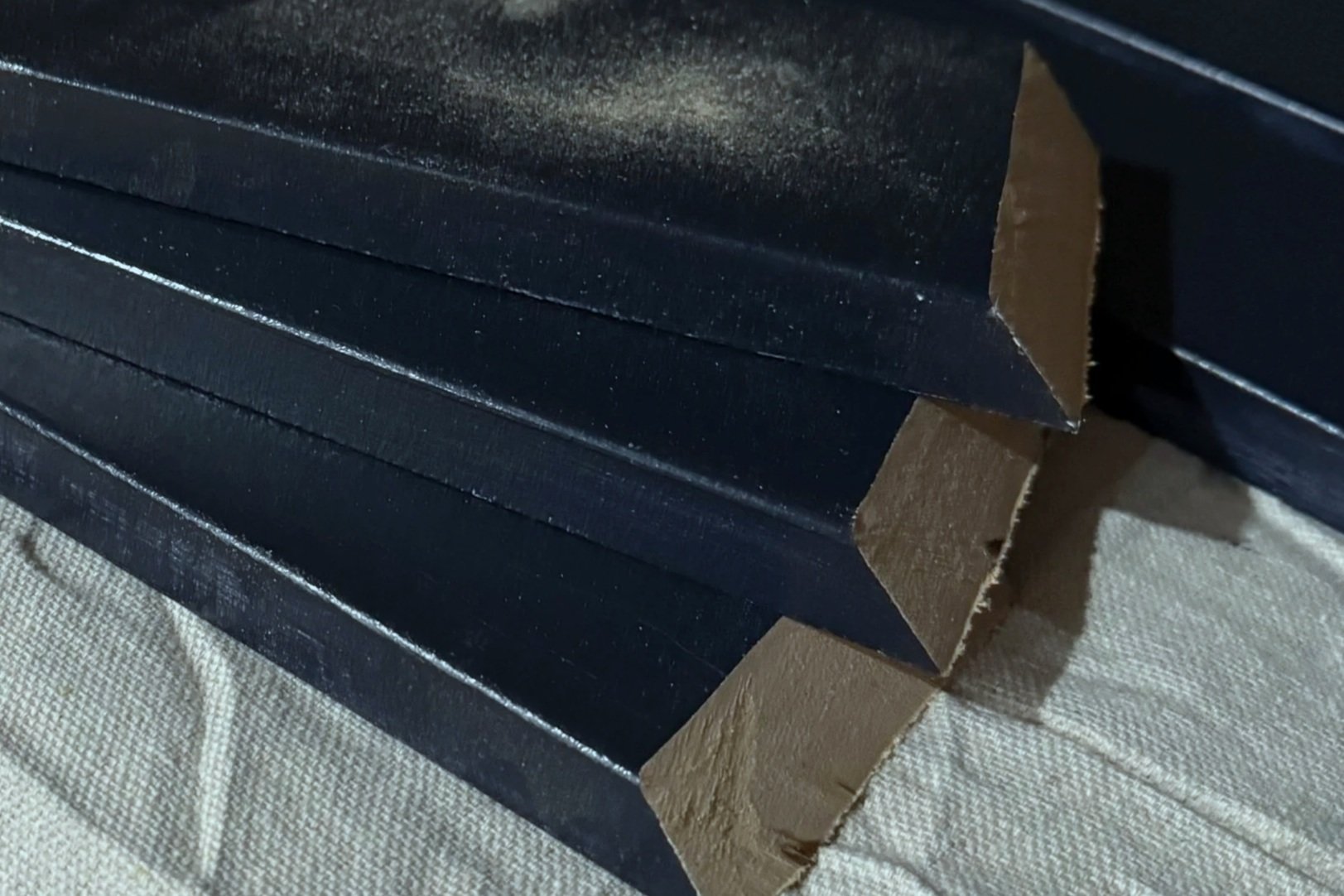
I’ve heard that bad things always come in sets of threes. And I suppose I’ve got enough evidence to lend an air of believability to it. One day our garage door spring snaps, the next I have a flat, then it’s just waiting for the third. It becomes a hunt of sorts. When will it strike? Where should I be preparing myself for the new problem?
I was thinking about that last week while working on the baseboard trim project we’re a year overdue in finishing. I thought about it after I made nearly the same cutting mistake for the third time in a row. Yes, I measured twice before cutting once, but that only helps if you measure correctly and then cut the right angle.
To cut myself some slack, it is tricky to measure when you’re dealing with angles, and pencil marks only show up on one side of the board. Not to mention going around a silly little one-foot wall nub that the builder decided would be cool to create the “illusion” that one long room was “kinda” two.
After the third bad cut, I decided it was time to be done for the day. I’ll come back to it when I’m mentally prepared for the math story problems I have to live with while doing these projects. And that was when I started wondering about the rule of three.
I started wondering why we look for it, and why it often proves itself out. And I came up with a couple of theories to consider. They may both be right or wrong at the same time. Let’s see how they fit.
First off, I wonder if when two bad things happen, we look for the third as a way of seeing an end to a season of hurt. To have one bad thing happen is a bummer. When two stack, it can feel like life is getting out of control. The purpose of any good superstition is getting a little of that back. Believing that there can be only one more event, braces you for it and also says, “This is almost over.” Just one more and we can move back to normalcy.
As to why it works, I gave myself an answer. After the third moment of frustration, I took away the opportunity to have a fourth by calling it a day. Can’t make another bad cut if I put the saw away, can I? Again, taking control in a way that protects myself from one more failure. In other situations, it might be choosing a different career path after the third setback. Or protecting yourself from a new relational hurt by drawing away from the pursuit of others. But again, a sense of control takes the steering wheel of life to say, “this far, but no farther”.
Then I was hit by the text I preached from yesterday. I was preaching from Matthew 10, while connecting to the moments of Palm Sunday. How Jesus reacted to crowds, how he was now sending his dearly loved disciples out like sheep among wolves. And he says this to them:
And whoever doesn’t take up his cross and follow me is not worthy of me.
Matthew 10:38 CSB
These words came long before Good Friday, which we celebrate in just a few days, but Jesus still points to this all too common symbol of Roman rule as the line of demarcation between those who would follow and those who would stay behind.
That made me think about God’s pattern of behavior through the Old Testament. He creates heaven and earth with such promise. He adds these people made in his image as the crowning moment. The addition of beings who were like Himself, able to love and give and create.
Then they choose to trust a snake and hunger over his directions for thriving. Then one of their boys kills the other one when he isn’t the favorite. Did God at this point say, “Ok, but at least there will only be one more?” Because then the descendant of Cain kills again and calls upon the grace God gave Cain to be an opportunity for vengeance against anyone who would seek justice. Did God, at this point, say, “Well, that’s three. Let’s call it a day,” as he hit the reset button on this whole “earth” and “humanity” idea?
The answer is no. The rule of three doesn’t seem to apply to God. Which is why there was a flood, betrayal by Ham, Abram being both a decent guy and a complete disaster, Isaac’s favoritism and lies, Jacob’s deceit, the selling of Joseph, the slavery in Egypt, and don’t even get me started on the roller coaster of disaster and repentance that is the book of Judges.
We put in a lot of work to limit our exposure to hurt, need, or discomfort. We protect ourselves with security, insurance, and even little superstitions to give ourselves a sense of control over it all. But the invitation of Jesus is the same invitation God gave Adam and Eve, Noah, and the people of Israel. Follow me into the hurt for the sake of another. Follow me, whatever the cost, because the restoration of God’s plan for humanity and this world is worth it.
And this week, as we remember Jesus’s arrival in Jerusalem and his walk toward his literal cross, we find the proof that this is true. Hebrews 12:2 tells us that Jesus looked at the cross through the lens of the “joy set before him”. And I wonder, does everything I do to protect myself end up limiting my potential for joy more than it protects me from hurt? Do the steps we take to seek out our own safety and security actually leave us missing out on something even better?
Bringing it back to something simple and safe, getting this trim project done will feel amazing. The areas that are now finished look great. It’s nice being in a place that feels complete. So tonight I’ll get the saw out and make a few more cuts. Maybe finish a room off. (Except this is the room that has the bay window where I’ll be dealing with 22.5° cuts instead of 45° cuts…wish me luck)
And as I work through this project, I’ll keep thinking about the ways I may be refusing crosses that would allow me to follow Jesus toward joy for the sake of keeping life safe and under control.